
If you are here, you attended or signed-up for one of our webinars! We are so glad you decided to join!
Please set up your FREE consult to explore how The Digital Hall with MonicaFaye can help boost your brand sales and increase traffic to your website.
As promised, your Free Downloads and the Building a Solid SEO Foundation webinar replay are below!
MonicaFaye, Your Digital Marketing Pro
Get your FREE copy of The Digital Hall’s Guideline to Google’s E-E-A-T structure. This is an easy and comprehensive layout of how Google views and assesses your website.


Download your FREE copy of SEO Best Practices!
This one-page guide navigates you through the SEO best practices and allows you to be your own SEO guru.
Download NOW!
A solid SEO foundation is the combination of technical setup, on-page optimization, content quality, and authority signals that make your website easy for both search engines and AI answer engines (Google, ChatGPT, Perplexity, Gemini) to understand, trust, and recommend. Without it, even the best content struggles to rank — and even the best ads struggle to convert.
At The Digital Hall, we build that foundation around four pillars: technical health, on-page relevance, content authority, and trust signals. Get these right, and every dollar you spend on marketing works harder.
Technical SEO is the behind-the-scenes work that lets search engines crawl, render, and index your site without friction. If a search engine can’t reach your pages — or if those pages load too slowly — nothing else matters.
The essentials we audit first include site speed and Core Web Vitals (Largest Contentful Paint, Interaction to Next Paint, and Cumulative Layout Shift), mobile responsiveness, a clean XML sitemap submitted to Google Search Console, a properly configured robots.txt file, secure HTTPS, structured data (schema.org markup), and a logical URL structure. Broken links, redirect chains, and duplicate content are silent killers we eliminate during this phase.
On-page SEO is how you tell search engines — and now AI engines — exactly what each page is about. Every page should target one primary keyword and a small cluster of related terms, and that intent needs to be reflected throughout the page.
The non-negotiables are a unique, keyword-rich title tag (under 60 characters), a compelling meta description (under 155 characters) that earns the click, a single H1 that matches the user’s search intent, and a logical H2/H3 heading hierarchy that breaks content into scannable sections. Images should use descriptive alt text, internal links should connect related pages with keyword-rich anchors, and your URL slug should be short and human-readable.
For Answer Engine Optimization, on-page work goes a step further: write self-contained answer paragraphs (40-60 words) directly under each heading so AI engines can lift them as citations.
Google’s E-E-A-T framework — Experience, Expertise, Authoritativeness, and Trustworthiness — is the standard search engines use to decide which sites deserve to rank. AI engines apply the same logic when choosing which sources to cite.
Strong foundational content does five things at once: it answers a real question your audience is asking, demonstrates first-hand experience with the topic, cites credible sources, is written by a clearly identified expert (with author bio and credentials), and is updated regularly so it stays accurate. Thin pages, AI-generated filler, and duplicate “doorway” content all erode authority — and once Google flags a site as low-quality, recovery takes months.
A practical rule we use with clients: every cornerstone page should be at least 1,200 words of original, useful content, supported by a cluster of related blog posts that link back to it.
Off-page SEO is everything that happens beyond your website — and it’s where credibility is earned or lost. Backlinks from reputable sites, brand mentions in industry publications, positive reviews on Google Business Profile and third-party platforms, and an active presence on the social channels your audience actually uses all signal trust.
For local businesses, a fully optimized Google Business Profile with accurate NAP (Name, Address, Phone) data, photos, posts, and consistent reviews is often the single biggest ranking lever. For B2B and ecommerce brands, strategic digital PR and guest contributions on authoritative industry sites do the heavy lifting.
The final layer of an SEO foundation is the analytics stack: Google Analytics 4, Google Search Console, and a rank-tracking tool reviewed monthly. Track organic traffic, keyword positions, click-through rate, conversion rate, and the pages AI engines are citing. Without measurement, SEO becomes guesswork — and guesswork doesn’t scale.
A solid SEO foundation isn’t a one-time project — it’s a system. Get the technical setup right, write content that genuinely helps your audience, earn authority signals from credible sources, and measure everything. Do that consistently for six to twelve months, and you’ll see what our clients see: compounding traffic, lower customer acquisition costs, and citations across Google, ChatGPT, Perplexity, and Gemini.
Ready to build that foundation for your business? Book your free consult →
An SEO foundation is the combination of technical setup, on-page optimization, content quality, and authority signals that make a website easy for search engines and AI answer engines to crawl, understand, trust, and recommend. It includes site speed, mobile responsiveness, clean URL structure, schema markup, keyword-targeted content, internal linking, and credible backlinks. Without this foundation in place, even the best content struggles to rank.
Most websites see meaningful SEO results within four to six months, with compounding gains continuing through months six to twelve. Technical fixes can produce wins within weeks, but ranking for competitive keywords, earning quality backlinks, and building topical authority is a longer game. Brand-new domains typically need nine to twelve months before they rank consistently on page one.
Technical SEO covers the behind-the-scenes infrastructure — site speed, crawlability, indexing, mobile responsiveness, HTTPS, structured data, and Core Web Vitals. On-page SEO covers the content and elements visible on each page — title tags, meta descriptions, headings, keyword usage, internal linking, image alt text, and content depth. Both work together: technical SEO lets search engines reach your pages, and on-page SEO tells them what those pages are about.
Yes — and arguably more than enterprises do. Small businesses typically can’t outspend competitors on paid ads forever, but they can win sustained organic traffic through SEO. Local SEO in particular (Google Business Profile, local citations, location-based keywords) delivers high-intent leads at a fraction of the cost of paid acquisition. For most small businesses, SEO is the highest-ROI marketing channel over a 12-month window.
Treat SEO as ongoing maintenance, not a one-time project. Run a full technical audit every quarter, refresh underperforming content every six months, monitor Google Search Console weekly for crawl errors and ranking shifts, and update your highest-traffic pages at least annually. Algorithm updates from Google and changes in how AI engines like ChatGPT and Perplexity cite sources require continuous adaptation.
The three Core Web Vitals are Largest Contentful Paint (LCP), which measures loading speed and should be under 2.5 seconds; Interaction to Next Paint (INP), which measures responsiveness and should be under 200 milliseconds; and Cumulative Layout Shift (CLS), which measures visual stability and should be under 0.1. These metrics are direct ranking signals and affect both user experience and conversion rates.
You can absolutely handle foundational SEO yourself if you have time to learn — basic on-page optimization, Google Business Profile, and content creation are accessible to anyone. However, technical SEO audits, link building, schema implementation, and competitive content strategy typically require specialized expertise. Most growing businesses get the best results by handling content in-house and partnering with an agency for technical and strategic work.
SEO optimizes your content to rank in traditional search engine results pages on Google and Bing. AEO (Answer Engine Optimization) optimizes your content to be cited and quoted by AI-powered answer engines like ChatGPT, Perplexity, Gemini, and Google’s AI Overviews. AEO requires clearer Q&A formatting, structured data like FAQPage schema, concise authoritative answers, and strong E-E-A-T signals. The two work together — solid SEO fundamentals are still the foundation that AEO builds on.
“Boosting SEO” means improving the signals that help your site rank higher and earn more organic visibility — faster page speed, stronger content, better internal linking, schema, and credible backlinks. We treat it as compounding, not a quick trick: every month of foundation work makes the next month’s rankings, traffic, and AI citations stronger.
01
With over 20 years of e-commerce and digital marketing experience MonicaFaye decided to leave corporate to help businesses like yours increase sales while building a better online presence.
02
Once you are a client, we don't ghost you. We are here to help your business win; when you win we win. And we like winning! We are leaving your ads on auto, we actually monitor and analyze performance. "
03
We offer Full Funnel services which means we complete the digital marketing circle. Your business in our hands delivers full impact all around when you select multiple services. SEO, CRO, and SEM go hand in hand at The Digital Hall. Let the traffic flow!
We are able to bring your vision to light while maintaining a best practices for UX/UI design and even research your target audience to ensure we get it right. We do all of this while keeping SEO top of mind, unlike many developers who simply provide a website that is pretty but doesn't perform.
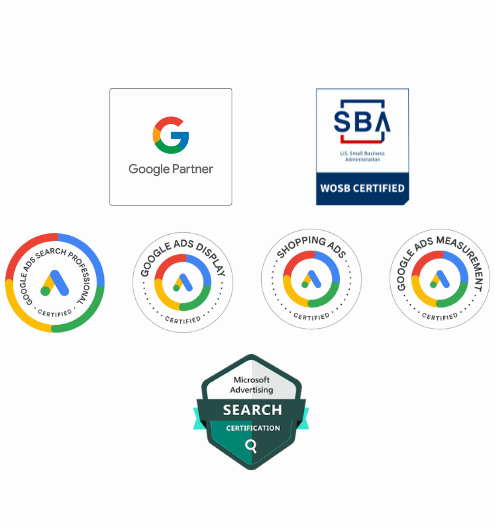
Our team also provide Google and Microsoft Advertising services as we are not only certified in Google Ads, Search, Shopping, Display, and Microsoft Search, We are also proud Google partners. Our goal is to fuse our SEO and CRO services into our SEM offerings to ensure our clients receive the full funnel experience.

The Digital Hall was founded on the principles of search engine optimization. We continued to see so many business owners paying for these beautiful websites but seemed to be getting nowhere fast. Hearing, 'I have a great website and look amazing! Why aren't we getting any traffic?' from owners was enough kick start our first offer, SEO. We can get traffic to your website and boost conversions.
Win and win BIG, that’s what we love to do! So we put every resource towards making BIG things happen for our clients. From creating captivating content that includes our in-depth keyword research and implementation to setting up, managing and analyzing your Google Ads and Microsoft Advertising accounts. We do it all to create a FULL FUNNEL DIGITAL SERVICE just for you!


